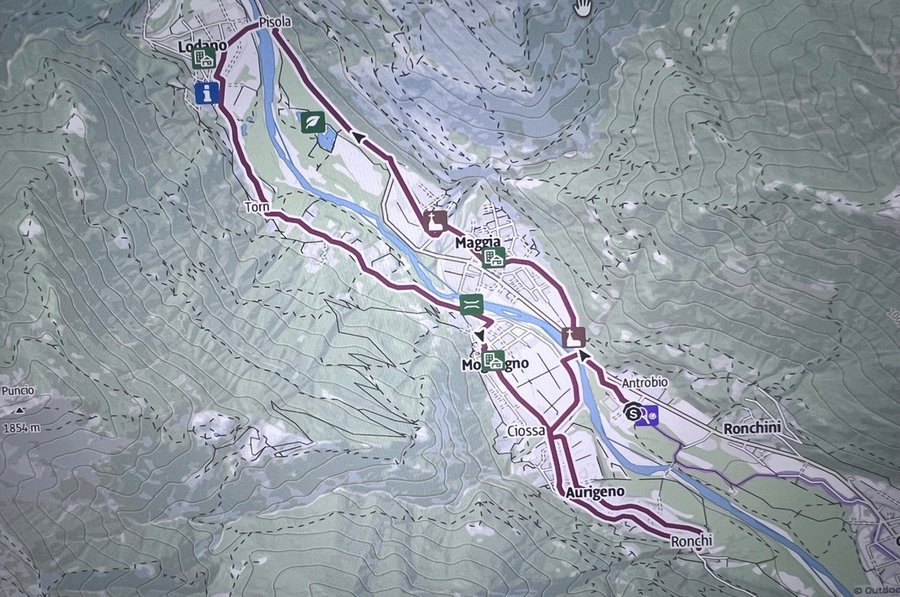
Moghegno, Lodano and Aurigeno are three villages in the lower Vallemaggia, situated on the right bank of the river, where time seems to have stood still.
Their historic centers are remarkably well-preserved. Perhaps partly because they lie off the main road running through the valley. These three villages are worth a brief visit, following the "Sentieri di pietra" guides available at the tourist office near the valley entrance in Avegno. The paths connecting the villages are also rich in valuable traces of the past. We recommend driving to Moghegno and starting from there heading up the valley along the approximately one-hour walk to Lodano. Alternatively, you can choose the opposite direction towards Aurigeno, the birthplace of the painter Vanoni, which can be reached in about 45 minutes.
Itinerary from Moghegno to Lodano
The charming village of Moghegno preserves numerous agricultural relics from the past: the mills that ground rye, the "grà" (drying huts) where chestnuts were dried for the winter, the 15th-century peat huts, and the grottos where wine was stored. And history has left even more ancient traces here: about forty Roman tombs, unearthed in 1994, evidence of which can be found in the Valmaggia Museum in Cevio. For a visit to Moghegno, see the itinerary indicated in the brochure "Stone Paths - Moghegno and the grà."
For your visit to Lodano, we recommend following the route outlined in the "Stone Paths – Lodano and the Vineyards" brochure. Following the signs, you set off along an easy path through vineyards and chestnut trees. Along the way, you'll encounter the beautiful settlement of Törn, which boasts interesting, tastefully restored buildings. Houses and stables were once built along the mule track, surrounded by vineyards in the valley and terraced ridges surrounded by protective walls upstream. Pergola-trained American grapes were grown there and hay was cut for the livestock. The village of Lodano has preserved its core with its ancient stone houses, the church of San Lorenzo, the patrician palace, the chapels, and the characteristic narrow streets. The tower house, a four-story building with external stairs leading to the main entrance, stands out for its slender shape. A beautiful 19th-century building has been transformed into a charming hotel «Ca' Serafina». In Lodano, you can also visit the valley of the same name, featuring a forest reserve and woods rich in chestnut, birch, beech, wild linden, and sessile oak trees. An information point displaying beautiful images is located in the village square, next to the town hall. To return to the starting point of our itinerary, we suggest leaving the village of Lodano and heading down towards the river. After a short walk along the paved road, you will come across a path on the left leading to the river. Continue along the Maggia River to the "Ponte" (Bridge) Chapel—a curious structure set amidst the meadows, featuring frescoes from various periods, including works by Vanoni. Then, head back up to the road to reach Moghegno.
Itinerary from Moghegno to Aurigeno
The route from Moghegno to Aurigeno shares similar characteristics with the path between Moghegno and Lodano. It winds through vineyards and chestnut groves, and the mule track is lined with numerous traces of traditional rural life. Here, too, the stables were built along the mule track. A visit to Aurigeno is of particular interest as it is the hometown of the painter Giovanni Antonio Vanoni (1810–1886), who trained in Milan and Rome, following the tradition of artistic emigration. A key figure in 19th-century folk art in Ticino, he is known for his religious paintings and *ex-voto* works, though he also distinguished himself as a portraitist. Traces of his work can be found throughout Aurigeno; in chapels, wall paintings, and votive niches. To discover this fascinating folk heritage of the Vallemaggia region, it is recommended to follow the route outlined in "Sentieri di pietra – Aurigeno e il Vanoni". To return to Moghegno, follow the paved road across the broad plain, where the charming Oratory of the Annunciation rises amidst the meadows. Although it is almost always closed, it houses frescoes by Vanoni, including an interesting depiction of the Flight into Egypt.
Edited by Carla and Giò Rezzonico
Translated by Google